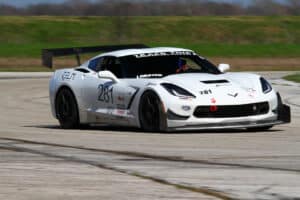
NASA Time Trial (NASA TT) is a National auto competition program, utilizing Regional series based on a time trial style format, with rules that establish car classifications to provide a contest of driver skill. NASA TT is designed to bridge the gap between NASA HPDE (High Performance Driving Events), and wheel-to-wheel racing. In most regions, we provide awards on a daily basis, and both awards and sponsor provided prizes on an annual basis for competition winners.
NASA TT provides a venue for spirited on-track competition with a high degree of both safety and convenience. NASA TT competition will take place during NASA HPDE-4 sessions or in separate TT run groups, depending on the event schedule and number of participants. In addition to having a set of National NASA TT Rules, the rules, safety guidelines, and driving requirements of the HPDE-4 program apply to NASA TT. These rules can be found in the NASA CCR (Club Codes and Regs).
The best part about the NASA TT series is that any closed-wheel street or racecar can be used to compete in this series. Each car gets placed into one of the nine NASA TT classes. For cars in classes TTA to TTF, classification begins with an assignment of a base class determined by the car’s original year, make, model, and equipment level specifications. Points are then assessed for any factory options or modifications done to the car, and after reaching 20, 40, 60, 80, 100, etc. modification points, the car is up-classed by one, two, three, four, five (etc.) classes, respectively. We have a computer program tool to help you determine you car classification here: TT Classer Program. We also have a completely unlimited class, TTR, and two semi-unlimited classes, TTU and TTS, where classing is based on an "Adjusted weight/power ratio" instead of using the modification points system. Cars in all classes may use non-DOT-approved racing tires, but will be assessed modification points in TTA-TTF, and a "modification factor" in TTU and TTS. NASA TT is a contest between drivers competing in a particular class; therefore, a driver may change or substitute a vehicle for one in the same class, and continue to accrue points toward the championship series for the season. We also have provisions in the rules for drivers that wish to compete together as teams.
TT drivers will generally have four 20-25 minute open passing run sessions at each event (although at times there are five sessions). Since an “event” is defined as a single day of regional competition, a typical NASA weekend is comprised of two events. NASA TT Competitors will be timed during each run session, and the fastest lap times of the day will be used to determine the winner of each class (The first session of each day is generally a warm-up session that does not count toward competition). Championship series points will be assigned to all competitors, and daily awards (medals, trophies, or certificates, etc) will be given up to third place, depending on the number of competitors in the class that day.
NASA TT competitors will receive points only in their respective NASA TT class and only within the region sanctioning the NASA TT event they are competing in. Certain multi-region events will be designated as “crossover events”, and the points earned by a driver at such an event will transfer to his or her respective home region’s championship series. However, a driver may also choose to simultaneously compete in more than one region’s championship series. In that case, crossover event points will be applied to both series. A driver must participate in a minimum of six event days to be eligible for championship series trophies, awards, or prizes at the end of the year. The points from every driver’s two lowest events of the year will be dropped (includes events that the driver was not present at). Every year in September, there is a National Championship event, which takes place at the Mid-Ohio Sports Car Course. The winner of each class at this event will be declared the NASA TT Champion of the year for their class. The 2007 eligibility requirement for the NASA Championships is that a driver must compete in at least 5 regional TT events (over a minimum of 4 days). Obtaining a certain minimum level of placing is not necessary in 2007.
Anyone wishing to enter a NASA sanctioned TT Series must meet the following requirements:
• Be at least 18 years old (16 or over with parental consent—see CCR section 3.6)
• Hold a current valid state driver’s license—see CCR section 3.6 for minors.
• Have use of an automobile that meets NASA’s technical requirements (CCR 11.4)
• Hold a NASA, or a NASA sanctioned car club, current membership. (NASA Membership)
• Have proper safety equipment, as per the CCR (Section 11.3—primarily an M95 or better helmet. The equipment requirements are no different than in HPDE.)
• Roll bar for all Convertibles. (Roll Bar Info) (CCR Section 11.4.7)
• Fully pay all applicable fees.
• Have no outstanding debts with NASA or NASA’s affiliates.
• Have knowledge of all of the rules found in the NASA National Time Trial rules and Club Codes and Regulations, and fully agree to abide by them.
• All drivers must be deemed physically fit by their physician to participate in a high stress and physically demanding sport such as auto racing (although a medical form is not required).
• Submit a signed waiver at each event (usually at the track gate upon arrival).
• Must be qualified to drive in the advanced, open-passing, HPDE-4 Group. Entrants will be screened by the TT Director to ensure compliance.
• Entrant must get their car teched before going to registration (Tech Sheets).
• Entrant must fill out the NASA TT Classification Form (TTA-TTF) or NASA TT Classification Form (TTR/TTU/TTS) before beginning competition.
Eligible drivers must complete a NASA TT License Application, and bring it to their first event (unless they have a NASA Competition Race License, in which case a TT License is not necessary). The Regional TT Director will sign the application after the driver successfully completes the first event if he approves the driver for a National TT License. The driver can then send the application and $10 to NASA to receive a TT License and be eligible for further TT competition in any region and at the NASA Championships.
All entered vehicles must be in good condition and appearance and must display a three-digit number on both sides of the car (10-inches high), and the rear of the car (4-inches high). Permanent NASA TT car numbers will be assigned by your Regional TT Director. All TT cars must also display a class designation on both sides and the rear of the car (4 inches high). Class designations shall be "TT" followed by the group letter. For example, an "A" Group competitor would display “TTA” as a class designation. All cars must meet the safety and car preparation standards specified at Section 11.4 of the NASA CCR. All convertibles must meet the roll bar specifications contained in the CCR for HPDE participation.
Please e-mail your Regional TT Director if you desire to compete, or if you just have questions. You can find your Regional Director’s e-mail address through the “Regional Info/Results” button above, on the “Contacts & Links” page for your region. You can also contact our National TT Director, Greg Greenbaum, at greg@nasa-tt.com We have a great group of drivers, and although the majority of us are pretty competitive, our main goal is to have fun. We often pit in the same area of the paddock, help each other out, and meet for Saturday dinner. Whether you are new to competition, a current racer, or someone who has years of racing experience that wants a lower stress level competition, we have something for you.